
Two weeks ago I guessed a few thousand people on the planet could fill a Legal Engineering Attorney req.
I was wrong. The ILTA roster says 67.
I ran every title on the September roster against the spec from a top Am Law firm: J.D., three years of practice, two years of legal engineering, prompts, JSON Schema, evaluation suites.
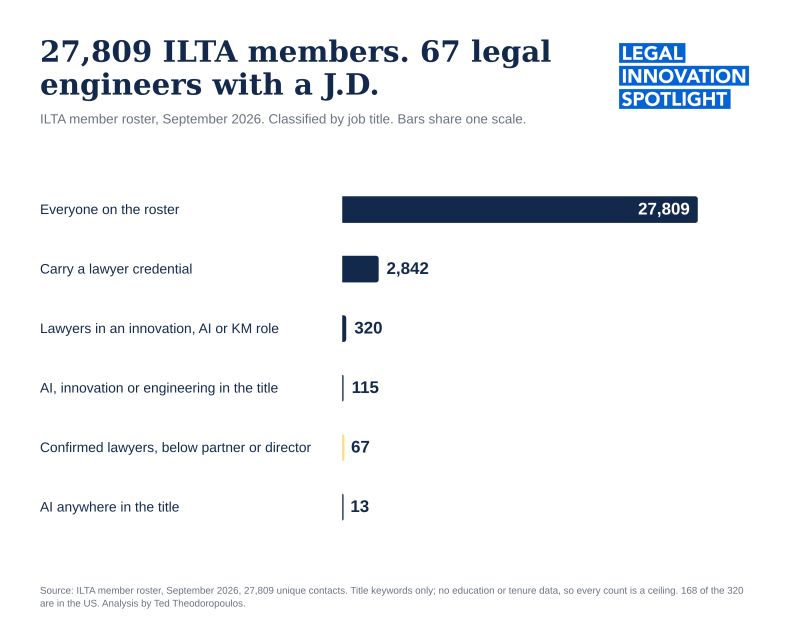
27,809 members.
2,842 indicate a JD.
320 are lawyers in an innovation, AI or knowledge role.
115 have AI, innovation or legal engineering in the title.
67 of those are lawyers below partner or director level.
13 have AI anywhere in the title.
Of the 16 people titled Legal Engineer or Knowledge Engineer, two are classified by ILTA as lawyers.
Where the 320 sit signals how competition for the roles will play out.
168 are in the US.
91 are in the UK (most of them PSLs) with 63% working at firms with more than 1,000 lawyers.
109 organizations, out of 1,098 on the roster, hold all 320.
The firm posting the req is recruiting from its own peer group's KM&I departments, and its peers are recruiting back.
Talent does not get created in that loop. It gets reshuffled.
You can't distinguish tenure or degrees from the job title, so the real number is likely smaller than 67.
Last time I said the fix is to break the role apart. The numbers say something more specific.
The two scarce skills are the two the req excludes without a law degree. The abundant skill is the one it requires.
A 1,000 lawyer firm has hundreds of people who can guide the process as it relates to legal work.
The whole industry has 67 who can do that plus the engineering, and they all already have a job.
The job reqs at law firms typically top out at $250K with no options. Harvey pays up to $320K plus equity.
How's that going to go? Instead firms might consider the following:
Write the req for a process engineer.
Write a second req for an AI engineer.
Pair both roles with a lawyer from the practice.
Three roles, two external hires, one is already on the payroll.
Or keep the J.D. requirement at $250K and plan for the seat to potentially stay open through 2027.
First published on LinkedIn. Read the thread and replies.
Ted Theodoropoulos is CEO and co-founder of Infodash and hosts the Legal Innovation Spotlight podcast. He writes about legal AI strategy, law firm technology, and the economics of the law firm business model.