
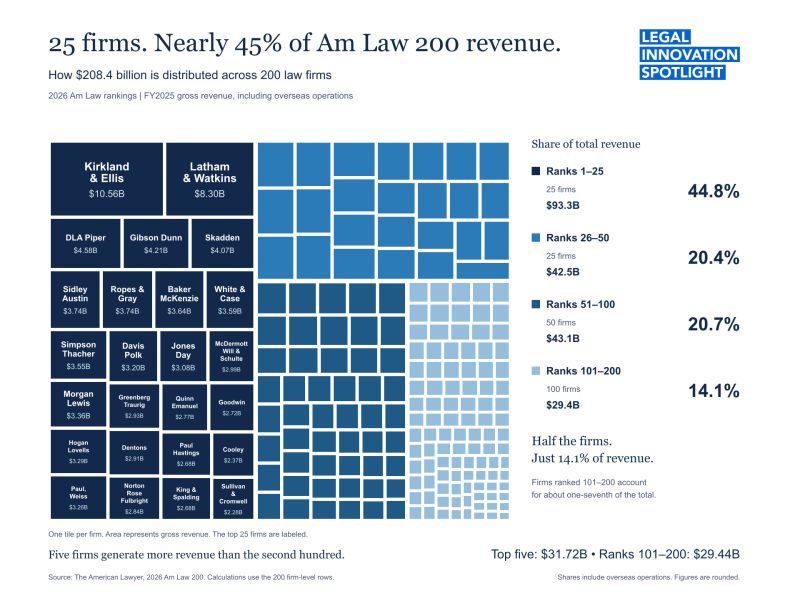
Five law firms generate more revenue than the entire Am Law second hundred.
Kirkland & Ellis. Latham & Watkins. DLA Piper. Gibson Dunn. Skadden.
Combined revenue: $31.7 billion
The 100 firms ranked 101–200: $29.4 billion
Each rectangle represents one firm, sized by its revenue.
A few numbers stand out:
• The top 25 firms generate nearly 45% of all Am Law 200 revenue.
• The top 50 account for roughly 65%.
• The second hundred account for just 14%.
We regularly talk about “Big Law” as though these firms operate in a similar fashion with comparable resources. They don't.
This picture shows how different the economics are across the Am Law.
And that matters when we talk about AI transformation.
Building a data foundation. Connecting systems. Fleshing out the org chart. Capturing institutional knowledge. Redesigning how work gets delivered. Taking risks.
Those investments require partner capital, specialized talent, and sustained leadership commitment and attention.
Even firms committing the same percentage of revenue can have dramatically different budgets to work with.
However, resources alone will not determine who will execute well.
Profitability, partner distributions, and leadership’s willingness to reinvest all matter.
A smaller firm with a focused strategy can move faster and make better decisions.
But the delta in resources should shape the strategy.
For a firm in the second hundred, the practical questions become:
• What do we need to own?
• What should we buy?
• Where could we share the cost?
• And which investments will actually differentiate us in the market?
“Do what the largest firms are doing” isn't viable when you have a fraction of their resources.
First published on LinkedIn. Read the thread and replies.
Ted Theodoropoulos is CEO and co-founder of Infodash and hosts the Legal Innovation Spotlight podcast. He writes about legal AI strategy, law firm technology, and the economics of the law firm business model.