
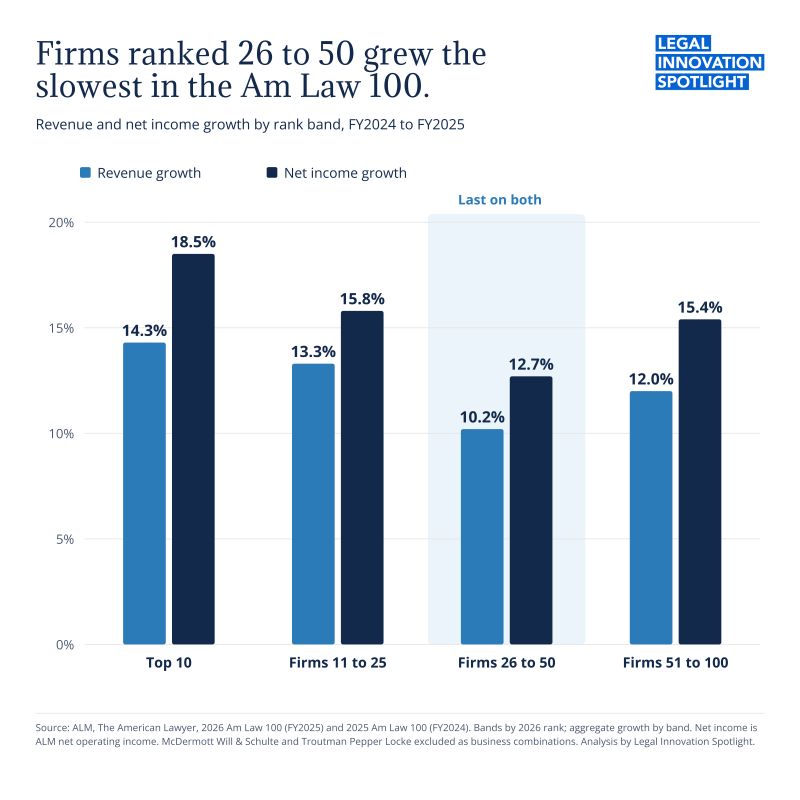
Firms ranked 26 to 50 grew the slowest in the Am Law 100.
Last on revenue, last on net income.
PwC found the same band slipping in the UK.
2025 Revenue growth:
• Top 10 up 14.3%
• Firms 11-25 up 13.3%
• Firms 26-50 up 10.2%
• Firms 51-100 up 12.0%
2025 Net income growth:
• Top 10 up 18.5%
• Firms 11-25 up 15.8%
• Firms 26-50 up 12.7%
• Firms 51-100 up 15.4%
Every band converted revenue growth into faster profit growth.
The firms below them did better on both measures with a 36.7% margin against the 26-50's 43.3%, and with a fraction of the headcount.
Then PwC published its 2026 Law Firm Survey this week. UK Top 100, 35th year, different market and different definitions, same dynamics in the top 26-50 firms.
UK firms ranked 26-50 grew fees 8.7% and profit 5.5%.
Profit has lagged fee growth in that band for four straight years. Net margin slipped to 24.0%.
They also raised rates more than any other band, 6.6%, and converted the least of it to profit.
UK firms ranked 51-100 grew fees 9.4% and profit 12.5%, beat their fee growth target, and now run a higher margin than the band above them.
PwC frames it as a question: is the 26-50 becoming the risky band, and the 51-100 the more attractive one?
It might very well be and I think the reason is the playbook.
A firm ranked 26-50 is big enough to carry a top 10 cost structure. Offices in the same cities. Lateral hires at top 10 prices.
An AI budget that doesn't have them fall too far behind firms like Kirkland and Latham.
They don't have to match what the top firms are doing but they also can't let them create too much distance.
But the firm isn't big enough to spread that cost across a top 10 revenue base.
The 51-100 can't afford to pretend. They pick two or three things and fund those.
The top 10 have the margin to be wrong a few times and keep going. The 26-50 have less margin for mistakes.
This data raises questions about the right strategy for firms ranked 26-50 and the firms below them might have the answer.
Don't try to keep up with the high risk/high reward bets the top 25 are making. Be selective and don't swing for the fences.
One year of US data is a signal, not a trend. The 26-50 were also the slowest growing band in the Am Law 50 in FY2024, but they converted revenue to profit well that year.
So the US pattern is two years on revenue and one on profit. The UK pattern is four years and counting.
This could very well be structural.
The question then becomes "How should it be dealt with?"
First published on LinkedIn. Read the thread and replies.
Ted Theodoropoulos is CEO and co-founder of Infodash and hosts the Legal Innovation Spotlight podcast. He writes about legal AI strategy, law firm technology, and the economics of the law firm business model.